
Routing Tables are a simple alternative to Smart Routers for directing calls to different endpoints when you manage a large number of tracking numbers. Instead of using complex logic, Routing Tables rely on a one-to-one match between a field value and a Routing Table Key to determine where a call should go.
CTM checks the value in the selected field and compares it to the keys in the Routing Table. If the value exactly matches a key, CTM follows the route associated with that key (such as a queue, receiving number, agent, or other endpoint). Otherwise, the activity will be routed to the selected default route.
The field used for matching can be any supported CTM field, including a tracking number, a custom field saved to the tracking number, or location data like city or state.
Watch our Routing Tables video walkthrough.
To set up a routing table, go to Flows→Routing Tables
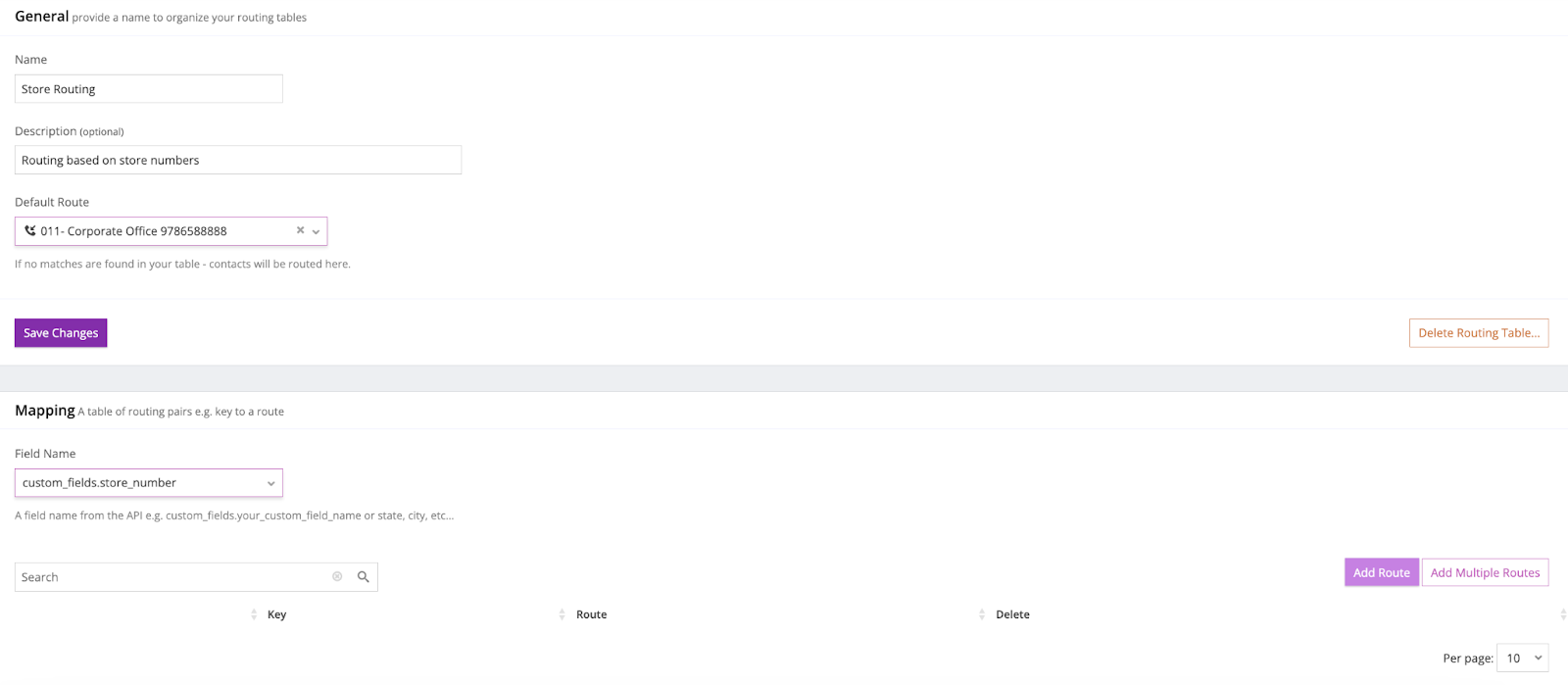
In the General Section:
- Give the route a name and description to keep them organized.
- Choose a default route (where calls will go if a route is not defined in the table) from the Default Route drop-down.
- Save changes.
In the Mapping Section:
- Select the field from the drop-down that will become the key that determines where the calls will be routed.
- Click Add Route.
- Enter your field value (key) in the Field Value box.
- Select the destination for the call in the Route To drop-down if the call has the above value.
- Click Save and Close if that is the only route being added, or click Save and Add Another to continue adding routes.
Example: Routing using a tracking number custom field.
Comments
Article is closed for comments.